5 min read
5 min read
Secretary of War points to Project Spectrum Strike to accelerate counter-drone fielding
Secretary of War points to Project Spectrum Strike to accelerate counter-drone fielding
Airbase

On October 2, 2026, the Department of War shared a memo from the Secretary of War Pete Hegseth directing the Pentagon to get counter-drone systems, or counter-unmanned aircraft systems (C-UAS), approved and into the field faster. One of the four barriers it names is spectrum certification and frequency assignment, the regulatory approvals a system needs to legally transmit radio-frequency (RF) signals.
The memo says spectrum approvals must “move at the speed of the UAS threat.” For that work, the memo highlights Project Spectrum Strike, a challenge run by the Defense Innovation Unit (DIU), the Pentagon’s office for rapidly adopting innovative commercial technology. In September, Airbase was named a winner.
Spectrum is a critical bottleneck
RF spectrum is the range of frequencies within the broader electromagnetic spectrum that radios, radars, GPS, and drones use to transmit and receive signals. It’s finite and shared, so every system that relies on spectrum must be authorized to operate on specific frequencies without interfering with others.
A counter-UAS system has two jobs: locate a hostile drone, then stop it. These often rely on radio signals. Radars send out signals to detect and track drones, while RF sensors listen for the signals a drone and its operator give off, which can reveal where each one is. To stop the drone, jammers are turned on to transmit signals that interfere with and disrupt its link to its controller or its GPS navigation.
Transmitters in that counter-UAS system need an equipment certification and a spectrum authorization before it can be used in live operations. Those approvals confirm that the system will not interfere with aircraft or nearby infrastructure that relies on the same frequencies. Securing this authorization can take months, sometimes years, and the memo calls out that delay directly. Removing this bottleneck is why Airbase exists, and is our sole focus through Project Spectrum Strike.
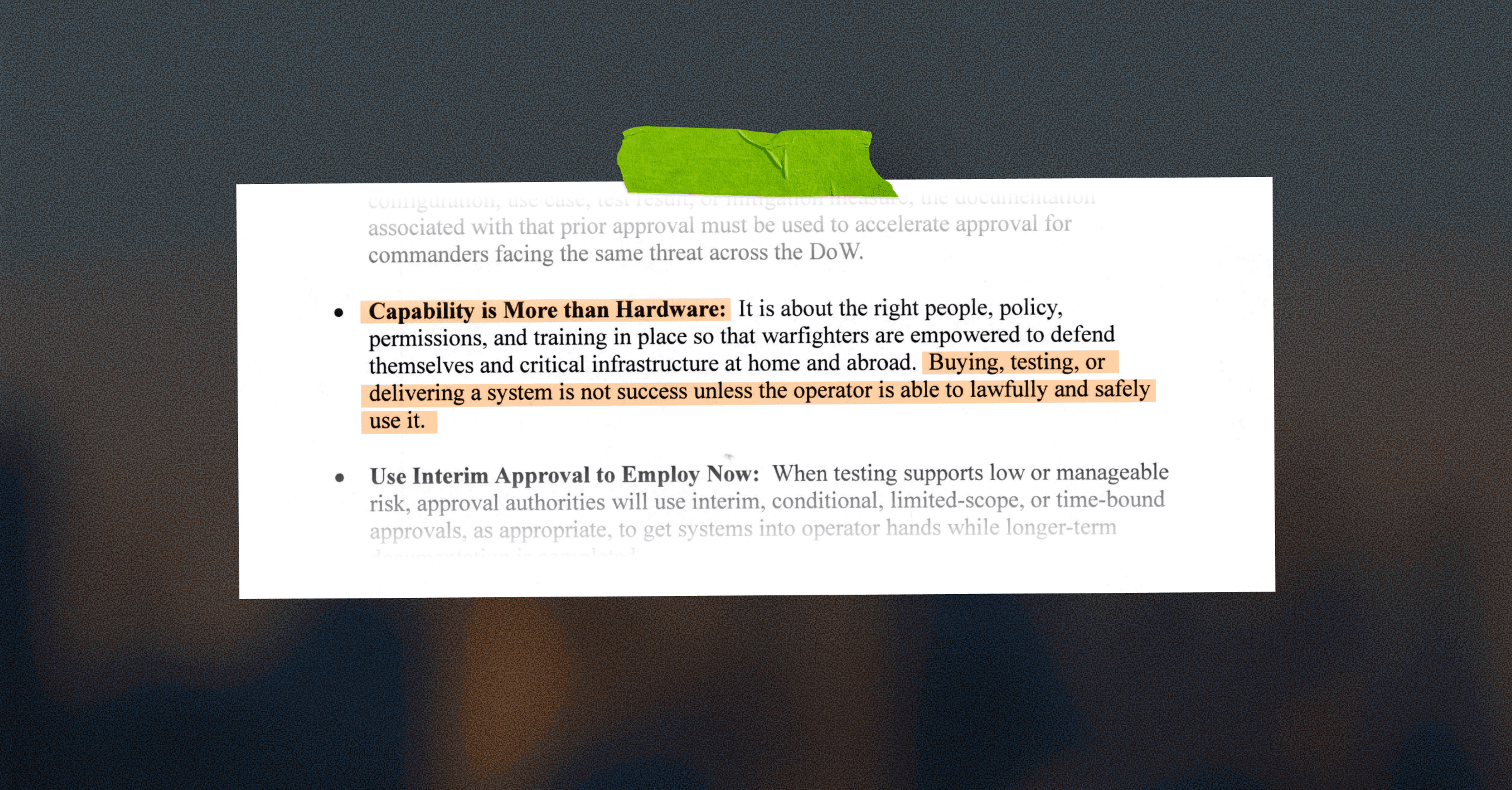
Secretary of War memo, Sept. 28, 2026, p. 2
What Project Spectrum Strike Demonstrated
This past August at a Fort Carson demonstration, alongside Drone Dominance Gauntlet 2, Airbase’s platform took equipment certification and spectrum authorization requests from creation to an approval decision in minutes. It ran on real data and did not miss any interference conflicts that could endanger aircraft and critical civilian services nearby.
Federal spectrum and aviation regulators (such as NTIA, FCC, & FAA) and DHS judged the demonstration alongside the Pentagon’s Chief Information Officer (DoW CIO), Army Spectrum Management, and soldiers from the 4th and 25th Infantry Divisions. Faster access came by working directly with regulators and spectrum managers to iterate on the product. They know this work better than anyone, and are forced to meet an exponential rise in spectrum requests with tools that are decades old.
The Mission Continues
When we founded Airbase, we wrote that bandwidth “should be negotiated by machines in milliseconds and not by humans over months and years.” This memo from the Secretary of War moves the Department toward this reality.
Project Spectrum Strike is part of the answer to the question this memo asks: once a system is acquired, how fast can operators use it?

Secretary of War memo, Sept. 28, 2026, p. 5
Today, the work behind a single request is spread across separate software systems, spreadsheets, and email threads. Our system of record brings it into one platform, where requester data like equipment certifications and mission details sits alongside the compliance checks, deconfliction, and RF analysis that reviewers and engineers run. AI handles the repetitive steps, like re-entering data, running routine checks, and enabling regulators to authorize automated approval workflows, so reviewers and engineers can focus on decisions that need their expertise.
Both requesters and reviewers work from the same record, and every data point and decision is traceable, so approved analyses can be reused and enable AI to automate certain parts of the approvals process. Over time, that record shows which requests are routine and well understood. Those can move toward automatic approval, while new or higher-risk requests get deeper expert review. For units in the field, that means getting access to frequencies used for routine exercises on an installation orders of magnitude faster. For spectrum managers, it means spending their time on the hard calls instead of data entry.
This work has been shaped by the very people who review these requests and the soldiers who depend on them. Thank you to DIU, the DoW CIO, the Pentagon’s counter-UAS task force JIATF-401, the Army, NTIA, FCC, FAA, DHS, and the soldiers of the 4th and 25th Infantry Divisions. We’re grateful to be part of this mission and excited for the work ahead.

Secretary of War memo, Sept. 28, 2026, p. 5
About Airbase
Airbase is an American early-stage company building the platform for RF spectrum management, licensing, coordination, and intelligence. We automate spectrum access for government, defense, and commercial operators. Airbase is backed by Andreessen Horowitz and Squadra Ventures.
We’re hiring in NYC across engineering, business development, go-to-market, and more. Join us to help fix America’s spectrum bottleneck.
On October 2, 2026, the Department of War shared a memo from the Secretary of War Pete Hegseth directing the Pentagon to get counter-drone systems, or counter-unmanned aircraft systems (C-UAS), approved and into the field faster. One of the four barriers it names is spectrum certification and frequency assignment, the regulatory approvals a system needs to legally transmit radio-frequency (RF) signals.
The memo says spectrum approvals must “move at the speed of the UAS threat.” For that work, the memo highlights Project Spectrum Strike, a challenge run by the Defense Innovation Unit (DIU), the Pentagon’s office for rapidly adopting innovative commercial technology. In September, Airbase was named a winner.
Spectrum is a critical bottleneck
RF spectrum is the range of frequencies within the broader electromagnetic spectrum that radios, radars, GPS, and drones use to transmit and receive signals. It’s finite and shared, so every system that relies on spectrum must be authorized to operate on specific frequencies without interfering with others.
A counter-UAS system has two jobs: locate a hostile drone, then stop it. These often rely on radio signals. Radars send out signals to detect and track drones, while RF sensors listen for the signals a drone and its operator give off, which can reveal where each one is. To stop the drone, jammers are turned on to transmit signals that interfere with and disrupt its link to its controller or its GPS navigation.
Transmitters in that counter-UAS system need an equipment certification and a spectrum authorization before it can be used in live operations. Those approvals confirm that the system will not interfere with aircraft or nearby infrastructure that relies on the same frequencies. Securing this authorization can take months, sometimes years, and the memo calls out that delay directly. Removing this bottleneck is why Airbase exists, and is our sole focus through Project Spectrum Strike.
Secretary of War memo, Sept. 28, 2026, p. 2
What Project Spectrum Strike Demonstrated
This past August at a Fort Carson demonstration, alongside Drone Dominance Gauntlet 2, Airbase’s platform took equipment certification and spectrum authorization requests from creation to an approval decision in minutes. It ran on real data and did not miss any interference conflicts that could endanger aircraft and critical civilian services nearby.
Federal spectrum and aviation regulators (such as NTIA, FCC, & FAA) and DHS judged the demonstration alongside the Pentagon’s Chief Information Officer (DoW CIO), Army Spectrum Management, and soldiers from the 4th and 25th Infantry Divisions. Faster access came by working directly with regulators and spectrum managers to iterate on the product. They know this work better than anyone, and are forced to meet an exponential rise in spectrum requests with tools that are decades old.
The Mission Continues
When we founded Airbase, we wrote that bandwidth “should be negotiated by machines in milliseconds and not by humans over months and years.” This memo from the Secretary of War moves the Department toward this reality.
Project Spectrum Strike is part of the answer to the question this memo asks: once a system is acquired, how fast can operators use it?
Secretary of War memo, Sept. 28, 2026, p. 5
Today, the work behind a single request is spread across separate software systems, spreadsheets, and email threads. Our system of record brings it into one platform, where requester data like equipment certifications and mission details sits alongside the compliance checks, deconfliction, and RF analysis that reviewers and engineers run. AI handles the repetitive steps, like re-entering data, running routine checks, and enabling regulators to authorize automated approval workflows, so reviewers and engineers can focus on decisions that need their expertise.
Both requesters and reviewers work from the same record, and every data point and decision is traceable, so approved analyses can be reused and enable AI to automate certain parts of the approvals process. Over time, that record shows which requests are routine and well understood. Those can move toward automatic approval, while new or higher-risk requests get deeper expert review. For units in the field, that means getting access to frequencies used for routine exercises on an installation orders of magnitude faster. For spectrum managers, it means spending their time on the hard calls instead of data entry.
This work has been shaped by the very people who review these requests and the soldiers who depend on them. Thank you to DIU, the DoW CIO, the Pentagon’s counter-UAS task force JIATF-401, the Army, NTIA, FCC, FAA, DHS, and the soldiers of the 4th and 25th Infantry Divisions. We’re grateful to be part of this mission and excited for the work ahead.
Secretary of War memo, Sept. 28, 2026, p. 5
About Airbase
Airbase is an American early-stage company building the platform for RF spectrum management, licensing, coordination, and intelligence. We automate spectrum access for government, defense, and commercial operators. Airbase is backed by Andreessen Horowitz and Squadra Ventures.
We’re hiring in NYC across engineering, business development, go-to-market, and more. Join us to help fix America’s spectrum bottleneck.
CONTACT
Dana Chou,
22:44
New York, NY. Proudly made in 🇺🇸
© 2026 Airbase Intelligence, Inc. All Rights Reserved.

22:44
New York, NY. Proudly made in 🇺🇸
© 2026 Airbase Intelligence, Inc. All Rights Reserved.
22:44
New York, NY. Proudly made in 🇺🇸
© 2026 Airbase Intelligence, Inc. All Rights Reserved.